


You are about to buy a property in Bangalore. Everything looks right: the location, the price, the seller. Then your bank or lawyer mentions three words: Encumbrance Certificate Bangalore. You have no idea what that is or why you suddenly need one.
Or perhaps you are selling a property, and the buyer’s agent has asked for an EC. Or you are applying for a home loan, and the bank has made it a mandatory requirement.
The Encumbrance Certificate (EC) is one of those documents that feels obscure until you need it, and then it becomes the most important document in your entire property transaction.
This guide explains everything about Encumbrance Certificate Bangalore: what it is, what it contains, why it matters, and exactly how to get one in Bangalore in 2026.
What Is an Encumbrance Certificate?
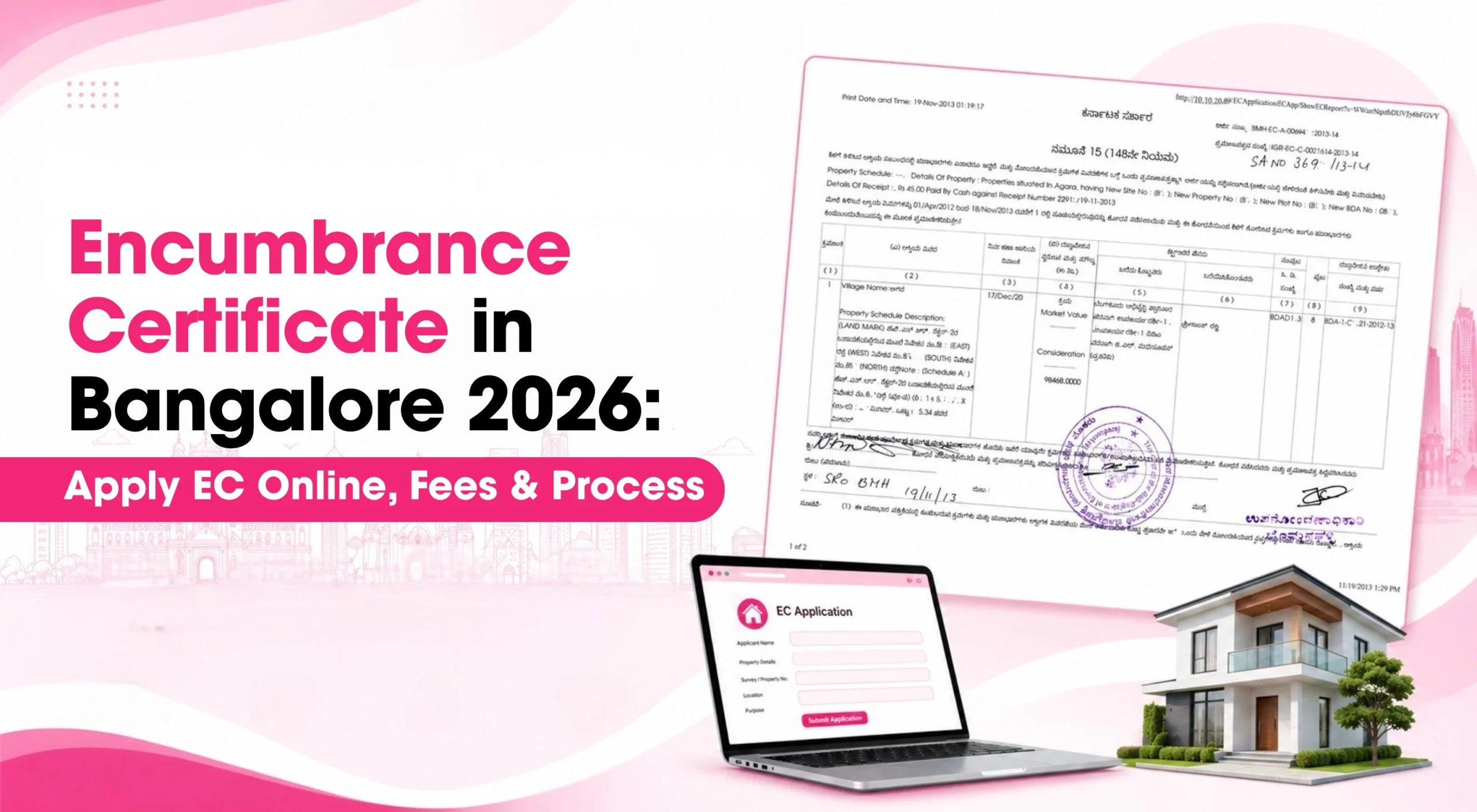
An Encumbrance Certificate (EC) is an official record of all financial and legal transactions registered against a specific property during a specific time period. It is issued by the Sub-Registrar’s office of the jurisdiction where the property is located.
The word ‘encumbrance‘ simply means a charge, claim, or liability on a property. An EC tells you whether any such charges exist or confirms that the property is free of all encumbrances (clear title) during the period you have requested.
What Information Does an EC Contain in Bangalore?
- Sale deeds: All registered sale transactions on the property — showing ownership history
- Mortgage details: Any home loan or mortgage registered against the property, along with the lending institution and loan amount
- Gift deeds: If ownership was transferred through a gift
- Release deeds: Discharge of a mortgage or loan after full repayment
- Partition deeds: Division of property among co-owners or family members
- Will or settlement: Registered will or family settlement that affected the property
- Lease agreements: Long-term leases (above 1 year) that have been registered
Note: An EC only captures registered transactions those formally registered with the Sub-Registrar’s office. Unregistered agreements or verbal arrangements do not appear in the EC. This is why Srimas Associates recommends additional due diligence alongside the EC for complete property verification.
Types of Encumbrance Certificates in Karnataka
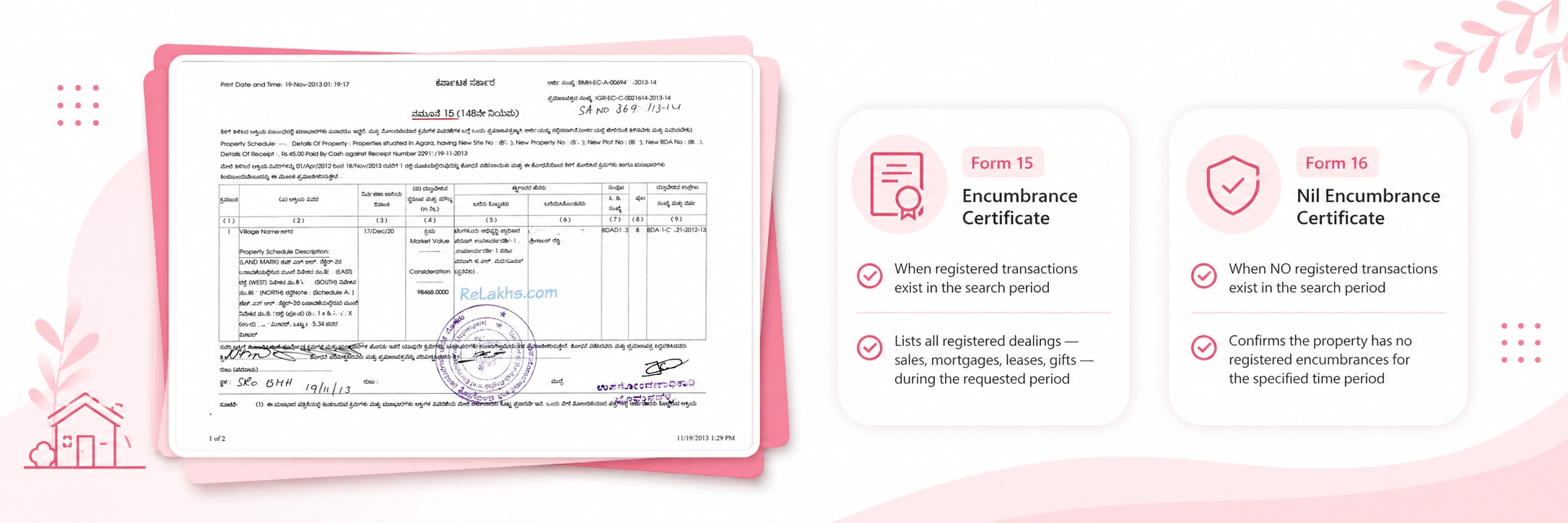
In Karnataka, an Encumbrance Certificate is issued in two forms, depending on the property’s transaction history:
Note: A Form 16 (Nil EC) is often misunderstood as proof of a clean title. It only means no transactions were registered during the search period — not that the property is free of all legal issues. Always seek legal advice for complete title verification.
Why Do You Need an Encumbrance Certificate in Bangalore?
The EC is not a document you apply for out of curiosity. It is required by law, by banks, and by any prudent property buyer in a specific set of situations:
- Before Buying a Property
This is the most critical use. Before you finalise a property purchase in Bangalore, you should obtain an EC covering the last 15-30 years — long enough to trace the ownership chain and identify any mortgage, loan, or legal claim that the seller has not disclosed. Because an encumbered property can become your legal and financial burden after purchase if not checked.
- For Home Loan Applications
Every bank, NBFC, and housing finance company in India requires an EC as a mandatory document before sanctioning a home loan. The EC confirms that the property has no existing mortgage, because the bank needs to establish its claim as the primary charge on the property.
- Most lenders require an EC covering 15-30 years, depending on the loan amount and property age
- If the EC shows an existing mortgage that has been discharged, the discharge document (release deed) must also be provided
- For Khata Transfer or Property Registration
Both the BBMP Khata transfers and the property re-registration processes require an EC to confirm that the property changing ownership is free of registered charges. For more details about the BBMP khata transfer, click on the article below:
- For Legal Proceedings
In property disputes, succession cases, and partition suits, the EC is critical evidence in court, establishing the chain of registered ownership and identifying any disputed transactions.
- For Government Schemes and Benefits
Certain government housing schemes, including PMAY (Pradhan Mantri Awas Yojana) require an EC as part of the documentation to verify that beneficiaries do not already hold a mortgaged or encumbered property.
How to apply for an EC Certificate Online in Bangalore
In 2026, the Karnataka Registration Department made the EC application fully available online through the Kaveri Online Services portal. You do not need to visit the Sub-Registrar’s office for most EC applications.
Step-by-Step: Kaveri Portal EC Application Process
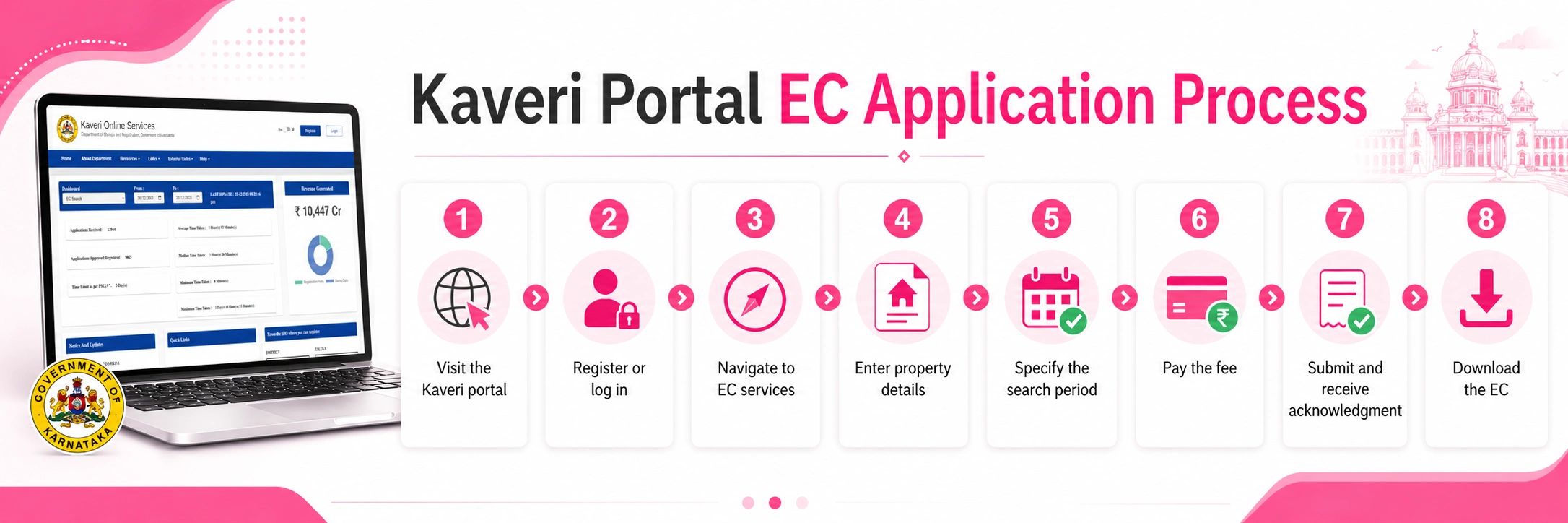
- Visit the Kaveri portal: Go to kaveri.karnataka.gov.in on a desktop browser
- Register or log in: Create a citizen account using your Aadhaar-linked mobile number or log in if already registered
- Navigate to EC services: Select ‘Encumbrance Certificate’ under the online services menu
- Enter property details: Fill in the property details, district, taluk, village/hobli, survey number, or property address
- Specify the search period: Enter the date range for which you need the EC (e.g., 01/01/2000 to today). Most banks require a minimum of 15-30 years.
- Pay the fee: Pay online via UPI, net banking, or debit card. Fee: Rs. 25-100 depending on the search period duration
- Submit and receive acknowledgment: Note your application reference number for tracking
- Download the EC: Once processed (typically within 30 minutes to 24 hours for most records), download the digitally signed EC as a PDF from the portal
How to Apply for an EC Certificate Offline at the Sub-Registrar’s Office
For properties not fully digitised on the Kaveri portal, you will need to apply in person at the Sub-Registrar’s office with jurisdiction over the property’s location.
- Documents needed: Property details (survey number, khata number, or property address), applicant identity proof (Aadhaar or PAN)
- Application form: Available at the Sub-Registrar’s office counter — fill in property details and specify the required search period
- Fee payment: Pay across the counter. Amount varies by search period — typically Rs. 2 per year of search, with a minimum of Rs. 25
- Processing time: 3-7 working days, depending on the Sub-Registrar office workload and property record status
- Collection: Collect the physical EC from the office on the notified date or track via the office’s acknowledgment slip
EC Application Fee and Processing Time in Bangalore
According to the Karnataka Registration Department Annual Report 2022-23, over 18 lakh Encumbrance Certificate applications were processed through the Kaveri portal in a single financial year, making it the most applied-for document in Karnataka’s property registration system. Thus, due to the busy and huge demand for EC, sometimes the processing time may vary from what is mentioned:
Note: Fees and processing times are as per the Karnataka Registration Department’s 2024-25 schedule. Minor variations may apply by Sub-Registrar zone. Always check the latest fee on the Kaveri portal before applying.
What to Look for When You Receive an EC
Receiving an EC is only half the job. The other half is reading and interpreting it correctly. Here is what to check:
- Property description matches: Confirm the survey number, khata number, and address shown in the EC match the property you are buying or selling
- The owner name chain is continuous: Every ownership transfer should appear in sequence, from seller to current owner. Any break in the chain raises a red flag
- Active mortgage vs discharged mortgage: If a mortgage appears in the EC, confirm whether it has been discharged. A discharge should appear as a subsequent Release Deed entry. If no discharge is visible, the mortgage may still be active
- No unknown transactions: Any entry not accounted for by the seller — a sale, gift, or lease you were not told about — needs immediate clarification before proceeding with the transaction
- Search period is sufficient: Confirm the EC covers the full period you requested. Gaps in coverage may indicate that records are not fully digitised for that period
Srimas Associates recommends:
Never interpret an EC alone for a high-value property transaction. An EC confirms registered transactions — it does not verify the validity of those transactions, identify fraudulent registrations, or reveal unregistered agreements. Srimas Associates provides a complete title opinion that goes beyond the EC to give you full legal clarity.
Conclusion
The Encumbrance Certificate is not bureaucratic paperwork; it is the document that stands between a secure property purchase and one that inherits someone else’s financial problem. In Bangalore’s active real estate market, where properties frequently change hands and loan records are complex, the EC is your first and most important line of verification.
Get it for every property you are seriously considering. Get it for the full period. Read it carefully. And if what you see raises questions, ask a lawyer before you sign anything.
Srimas Associates provides EC applications, title searches, property legal opinions, Khata transfers, and complete property documentation services for buyers and sellers across Bangalore. If you need an EC or want a full title verification before a property transaction, contact us for a free initial assessment.
Frequently Asked Questions

Sangeetha Mahesh Author
Sangeetha Mahesh is the founder of SriMas Associate, a company that helps people with licenses, insurance, and managing properties. She has studied many subjects like B.Com, MA, and LLB, and has over 15 years of experience in helping businesses and individuals with complicated rules and managing their assets. Sangeetha's work is focused on providing solutions that are good for her clients, and she works hard to give the best service. On her blog, she shares helpful tips and advice about licenses, insurance, and property management, so that her readers can make smart choices.