


- By Sangeetha Mahesh
- January 9, 2026
The e-swathu online system program has enabled the Government of Karnataka to change the way property and land records are managed in the State. Be it a rural property owner or land details in a Gram Panchayat, it is important to know how to apply for e-swathu. The scheme assists citizens in obtaining official property ownership and tax records in digital form without going to local offices.
This is a full-fledged guide that covers all required documents, 2025 fee changes, and application status monitoring. By the end, you will know how to fill out the e-swathu application form easily and effectively through the official portal.
What Is the E-Swathu Application?
The e-swathu online application is a government initiative operated by the Rural Development and Panchayat Raj Department (RDPR) of Karnataka. It enables property owners to check and manage land ownership information through an online portal. This system replaces manual records and makes property data management faster, more transparent, and tamper-proof.
By applying for e-swathu Form 9, you receive an extract of the Property Register with ownership details.
Similarly, e-swathu Form 11 provides a Mutation Register Extract that records ownership changes due to sale, inheritance, or transfer. Both documents are easily accessible and verifiable online, reducing physical visits.
Also Read: e-Swathu: A Complete Overview of Karnataka’s Digital Property Record Portal
Documents Required for E-Swathu in Karnataka
Before starting the e-swathu online application, ensure you have the required documents. If your property falls under BBMP limits, check the list of documents required for E-Khata. The major documents required for e-swathu in Karnataka are:
- Proof of Property Ownership: Sale deed, gift deed, or partition deed
- Encumbrance Certificate (EC): Confirms the property is free from legal liabilities
- Latest Property Tax Receipts
- Aadhaar Card or valid ID proof
- Survey or Layout Plan showing land boundaries
- Previous Form 9 or Form 11 (if available)
Step-by-Step Guide: How to Apply for E-Swathu Online
Applying for E-Swathu in Karnataka is now simpler, but confusion still exists. Below is a clear step-by-step guide to help you complete the process through your Gram Panchayat.
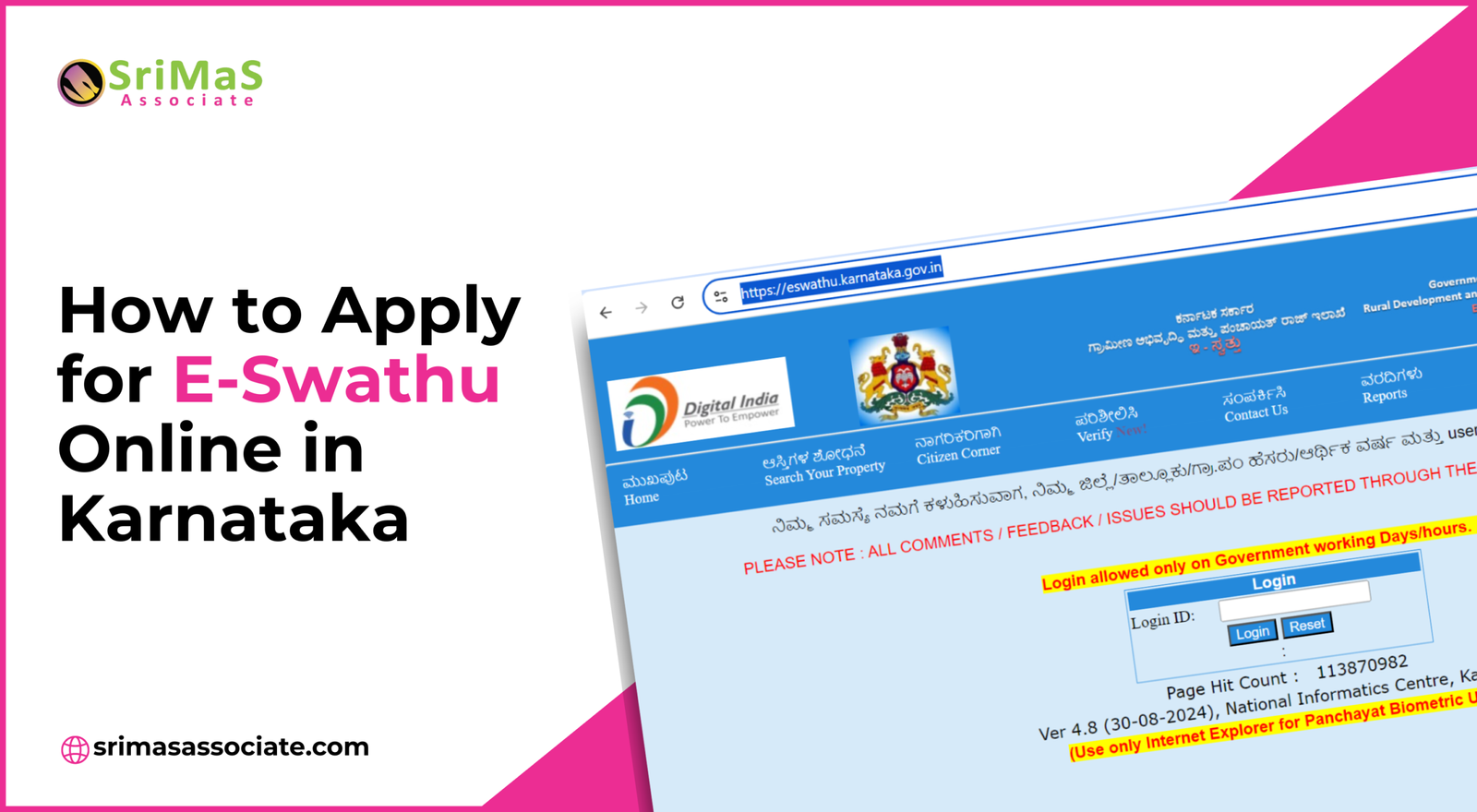
Step 1: Go to the Official Portal
Visit the official e-swathu portal operated by RDPR.
Step 2: Collect All Mandatory Documents
- Village Map
- Aadhaar Card
- Latest House Tax Receipt
- Survey Report
- GPS-tagged photo of the house or site
- Sale deed or registration documents (if available)
These documents are required for verification and generation of Form 9 and Form 11.
Also Read: Difference Between 11A and 11B Khata
Step 3: Apply for Form No. 9
Form No. 9 (Namune 9) is mandatory for properties within village limits.
- Visit your Gram Panchayat office
- Submit village map, Aadhaar, tax receipt, and survey report
- Panchayat verifies details and issues Form No. 9
This form establishes the identity and ownership of your property.
Step 4: Apply for Form No. 11
- Property tax payments
- Building permission
- Ownership updates
Form No. 11 is issued by the Gram Panchayat after document verification.
Step 5: Submit the E-Swathu Application
Submit Form 9, Form 11, Aadhaar card, GPS photo, and property documents at the Panchayat office. You will receive an acknowledgement number, which is used to track application status.
Step 6: Pay Applicable Fees
- ₹50 – For properties with an existing Form 9 or property number
- ₹1000 (approx.) – For newly regularised revenue sites
Step 7: Verification and Objection Notice
- Details entered into the e-swathu software
- Application forwarded to PDO login
- 21-day public objection notice issued
If no objections are raised, the application proceeds to approval.
Step 8: Receive Your E-Swathu Certificate
After approval, you will receive the official E-Swathu Certificate from the Gram Panchayat. Under the Sakala scheme, the process must be completed within 45 days.
Conclusion
The E-Swathu online application has transformed rural property management in Karnataka by making it digital, transparent, and efficient. Forms 9 and 11 act as verified proof of ownership and are essential for property-related transactions.
For understanding how E-Swathu differs from other Khata types, read: Different Types of Khata in Karnataka
Frequently Asked Questions
Can I apply for e-Swathu without visiting the Gram Panchayat?
Yes, you can apply for E-Swathu without visiting the Gram Panchayat. The entire process is designed for online completion. You can simply visit the official website. Fill out the required form and submit the form any time.
How many days will it take to get e-Swathu in 2025?
In 2025, the E-Swathu platform will take 5 to 15 days to process your request once you submit your application. If there is a delay in your application, there might be a mismatch of your details or documents. Hence, it is suggested to track your application within 5 to 6 days.
Is Aadhaar mandatory for e-Swathu applications?
Yes, an Aadhaar card is a required document for the E-Swathu application. It acts as an identity verification document, but if you do not have an Aadhaar card, then you can also provide other identification proof.
Can an NRI apply online for e-Swathu?
Yes, NRIs can apply for E-Swathu online. They must have to provide their valid proof of identity, like a passport, which will be used to authorise their identity.
What if my property is within the BBMP limit?
If your property comes under BBMP jurisdiction, you can apply for a digital E-Khata through the BBMP portal. In addition, you must pay a property tax for BBMP properties.

Sangeetha Mahesh Author
Sangeetha Mahesh is the founder of SriMas Associate, a company that helps people with licenses, insurance, and managing properties. She has studied many subjects like B.Com, MA, and LLB, and has over 15 years of experience in helping businesses and individuals with complicated rules and managing their assets. Sangeetha's work is focused on providing solutions that are good for her clients, and she works hard to give the best service. On her blog, she shares helpful tips and advice about licenses, insurance, and property management, so that her readers can make smart choices.